
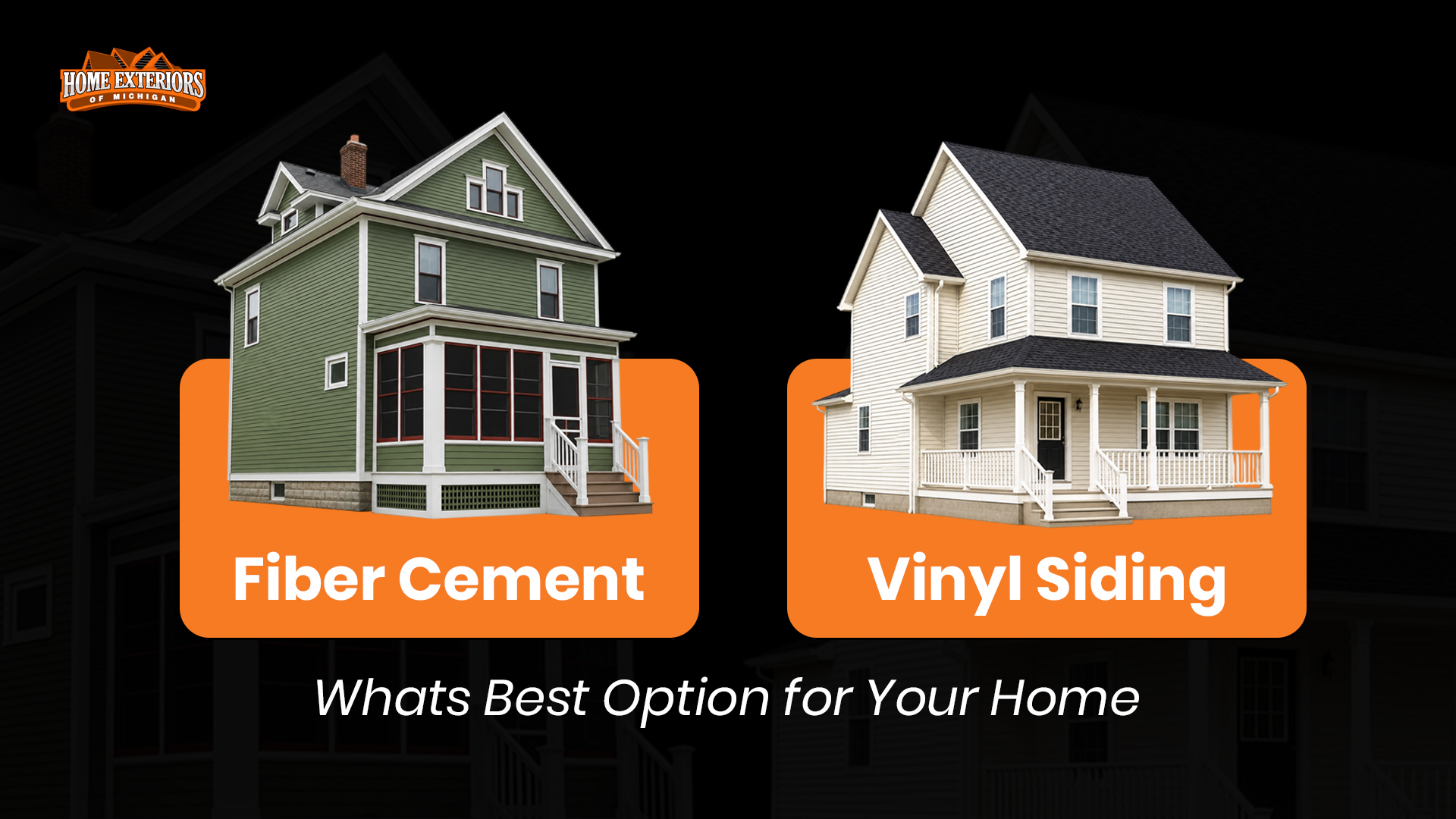
If you’ve started researching new siding for your house, you’ve probably noticed the conversation almost always narrows down to two names: fiber cement and vinyl. Every contractor has an opinion. Every neighbor has a horror story. And every siding brochure claims to be the “best value” on the market.
Here’s the truth: there isn’t one universally “better” siding material; there’s a better material for you. Your budget, your climate, how long you plan to stay in your home, and how much upkeep you’re willing to do all shape the right answer.
We break down exactly how fiber cement and vinyl siding stack up on cost, durability, maintenance, curb appeal, and resale value so you can walk into your next contractor conversation knowing precisely what you want.
What Is Vinyl Siding?
Vinyl siding is a plastic-based exterior cladding made primarily from PVC (polyvinyl chloride). It comes pre-colored, meaning the pigment runs through the entire panel rather than sitting on top as paint, and it’s engineered to snap together in interlocking panels, which makes it one of the fastest siding materials to install.
It’s been the go-to choice for American homeowners for decades, largely because it’s affordable, lightweight, and low-maintenance. Modern vinyl has also come a long way from the flat, plasticky look of older versions; today’s premium lines offer wood-grain textures, deeper color palettes, and insulated backing for better energy efficiency.
What Is Fiber Cement Siding?
Fiber cement siding is a composite material made from a blend of cement, sand, cellulose fibers, and water, pressed into planks, shingles, or panels. James Hardie is the best-known brand in this category, so much so that many homeowners simply refer to fiber cement as “Hardie board.”
Because it’s cement-based, fiber cement is significantly heavier and denser than vinyl, roughly five times thicker in most product lines. That added mass is exactly what gives it a reputation for durability, fire resistance, and a more authentic wood-like appearance that holds paint beautifully.
Fiber Cement vs. Vinyl Siding: Comparison
1. Cost: Upfront Price vs. Long-Term Spend
This is usually where the decision starts. Vinyl siding typically costs $4 to $12 per square foot installed, while fiber cement runs $6 to $15 per square foot installed, roughly a 40–60% premium.
For a typical 2,000-square-foot home, that translates to:
Vinyl: $8,000 – $16,000 total
Fiber cement: $14,000 – $28,000 total
Why the gap? Fiber cement is heavier and harder to cut, which means longer installation time, specialized tools, and a larger crew, all of which drive labor costs up. Vinyl, by contrast, is lightweight and snaps into place quickly, keeping both material and labor costs lower.
But cost isn’t just about day one. Because vinyl doesn’t need repainting and fiber cement (unless factory pre-finished) may need a fresh coat every 10 to 15 years, it’s worth thinking in terms of cost per year of ownership, not just the initial invoice.
2. Durability and Lifespan
Fiber cement generally outlasts vinyl. Expect 30 to 50 years from fiber cement siding versus 20 to 40 years from vinyl, assuming proper installation in both cases.
Fiber cement also handles physical stress better. It resists hail, flying debris, and impact damage far more effectively than vinyl, which can crack in cold weather or dent from a stray baseball. On the flip side, vinyl has one advantage in extreme heat: because it’s plastic, it can warp or buckle if installed too close to a reflective window or a grill, something fiber cement simply doesn’t experience.
3. Maintenance Requirements
This is where the two materials really diverge in philosophy.
Vinyl siding is essentially maintenance-free. Because colour is baked into the material, there’s no repainting just an occasional rinse with a garden hose to knock off dirt and pollen.
Fiber cement siding needs a bit more attention. If it’s field-painted, plan on repainting every 7 to 15 years. Pre-finished fiber cement (factory-baked colour) can go 15+ years before it needs attention. You’ll also want to inspect joints and caulking periodically to keep moisture out, since fiber cement, unlike vinyl, can absorb water if the protective coating is compromised.
4. Fire and Weather Resistance
If you live somewhere with wildfire risk, this factor alone might settle the debate. Fiber cement is non-combustible, making it a top choice in fire-prone regions and often a requirement in certain building codes. Vinyl, being a petroleum-based plastic, will soften, melt, or ignite under high heat.
In storm-heavy climates, fiber cement’s density also gives it an edge against wind-driven debris and hail, while lighter-gauge vinyl is more prone to cracking or blowing off in severe weather.
5. Curb Appeal and Design Flexibility
Vinyl has closed the design gap significantly in recent years, with realistic wood-grain textures, deep color saturation, and options like insulated or board-and-batten profiles. Still, up close, most vinyl reads as “siding” rather than natural material.
Fiber cement, on the other hand, is prized for how convincingly it mimics wood clapboard, shingle, or stucco finishes, a big reason it’s the material of choice for craftsman, farmhouse, and traditional architectural styles. It also holds paint like real wood, letting homeowners fully customise colour rather than choosing from a pre-set vinyl palette.
6. Environmental Impact
Neither material is perfectly “green,” but they differ in footprint. Vinyl is a petroleum-derived plastic that isn’t biodegradable and is harder to recycle in most municipal systems. Fiber cement uses natural raw materials (cement, sand, cellulose) and, because of its long lifespan, generates less replacement waste over a home’s lifetime, though its manufacturing process is more energy-intensive.
7. Resale Value and ROI
According to industry remodelling cost-value data, both siding types tend to recoup a strong percentage of their cost at resale, but fiber cement often edges out vinyl in return on investment, particularly in higher-end neighbourhoods where buyers associate it with quality and low future maintenance. Vinyl still performs well in cost-conscious markets, where buyers prioritize affordability over premium materials.
Which Siding Is Best for Your Home?
There’s no single right answer, but there is a right answer for your situation. Here’s a simple way to think about it:
Choose vinyl siding if:
You want the lowest upfront cost
You plan to sell or move within the next 10–15 years
You want a fast, low-hassle installation
Low maintenance is your top priority
Choose fiber cement siding if:
You’re planning to stay in your home long-term
You live in a wildfire-prone or storm-heavy climate
You want the most authentic, high-end wood-look finish
You’re willing to invest more upfront for lower lifetime replacement costs
Conclusion
Both fiber cement and vinyl siding are proven, popular choices; together, they cover the majority of home exteriors across the country for good reason. Vinyl gives you affordability and simplicity. Fiber cement gives you durability, authenticity, and long-term resilience.
The best move before you decide? Get quotes for both from a licensed local contractor, ask to see physical samples in your home’s lighting, and factor in not just the installation cost, but the total cost of ownership over the next 20–30 years. That’s the number that actually matters.
Need Siding Repair, Replacement, or Installation in Michigan? Choose Home Exterior of Michigan for professional siding services.
Get a Free Estimate Today